We Shall Overcome: The Making of an Anthem
On the morning of 28 August 1963, Joan Baez stood before a quarter of a million people gathered on the National Mall and led them in "We Shall Overcome." Later that afternoon, from the same platform, Martin Luther King Jr. would deliver the famous speech "I Have a Dream". We will come back to that afternoon. But by the time Joan Baez started singing that morning, the song already carried a history far longer than the movement that had adopted it.
That history runs along two lines that only meet quite late. The melody has one lineage, running from a Catholic hymn sung by Sicilian sailors in the eighteenth century, through German Romantic folklore and two of Europe's greatest composers, into nineteenth-century American hymn books. The words and their sentiment have an entirely separate lineage, running through Black American gospel hymns, a mining strike, and a tobacco workers' picket line. This is an attempt to reconstruct that history as fully as the surviving documentation allows, and it is really three histories at once. It is the story of how a protest song grows, verse by verse, out of the concrete experience of the people singing it. It is the story of a simple, haunting musical phrase that has lodged itself in an improbable range of minds over two and a half centuries. And it is, not least, the story of who gets remembered for that work and who does not, a pattern, running through this song's whole documented life, in which the people credited on paper have disproportionately been white and male, while a great deal of the song's actual creative labour, especially at its most decisive turns, was done by Black women.
The history of the melody
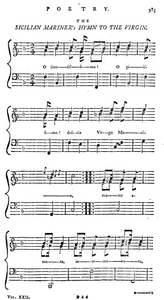 The paper trail begins in Sicily, and not as protest but as devotion. In November 1792 the European Magazine and London Review, vol. 22, published a short, anonymous item describing "the effects of the simple air called 'The Virgin's Hymn,' sung in unison by the whole crew of the Sicilian seamen on board their ships when the sun sets, or when it is the twenty-fourth hour of Italy" complete with musical notation, under the title "The Sicilian Mariner's Hymn to the Virgin." [1] It gives both the Latin text and an English translation:
O sanctissima, o piissima, dulcis Virgo Maria, mater amata, intemerata, ora pro nobis.
O spotless Virgin, mother dear, Thou holy pious Virgin hear; To thee our suppliant lays we pour, For wretched fallen man implore.
This item is very often described as coming directly from the pen of Charles Burney, the era's leading English music historian. Like nearly everything printed in the European Magazine, the piece appeared unsigned, and it does not, on inspection, present itself as Burney's own eyewitness account. It was in fact one instalment, number thirty-eight, of a recurring column called "Drossiana" and its actual author was identified as William Seward, an English man of letters and inveterate anecdote-collector who had travelled extensively in Italy, moved in the same London circles as the Burney family, and had been contributing "Drossiana" to the magazine, mostly anonymously, since October 1789. [2]
In the same period, the Welsh harpist and collector Edward Jones published the same tune, as "The Prayer of the Sicilian Mariners" in an undated volume of his Miscellaneous Collection of French and Italian Ariettas that modern cataloguers place at around 1790, possibly a year or two before Seward's article.
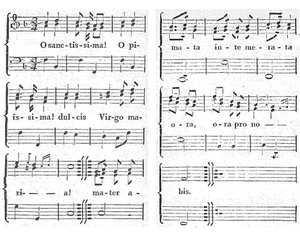 Fifteen years on, the tune resurfaces in a very different context: the German philosopher and folklorist Johann Gottfried Herder's Stimmen der Völker in Liedern ("Voices of the Peoples in Songs"), published posthumously in Tübingen in 1807. Herder had spent much of his life collecting and annotating folk songs from across Europe; his first collection had appeared just before his death in 1803, but the 1807 edition added further material from his papers, including, under the title "An die Jungfrau Marie" the same "O Sanctissima" text, attributed to Sicilian sailors and probably collected during Herder's travels in Italy in 1788. [3] It was, notably, the only song printed with music notation anywhere in Herder's multi-volume anthology. Herder may have collected the song himself, on his own 1788 trip to Italy, or simply drawn on the English text already in print.
Regardless of who is properly credited with the transcription, it is worth situating Burney's and Herder's roles here within the broader intellectual practice they both belonged to. Both men were, in effect, collectors: Enlightenment and early Romantic figures who travelled, or drew on others' travels, to catalogue the musical "customs" of peoples they regarded, implicitly or explicitly, as other than themselves, for the benefit of a metropolitan, literate readership back home. This was not a neutral or innocent activity. Vanessa Agnew's study of Burney and his contemporaries, Enlightenment Orpheus: The Power of Music in Other Worlds (2008), argues that eighteenth-century touring and cataloguing of regional and non-European musical practice was bound up with a wider Enlightenment project of using music to rank cultures on a civilisational scale, with London and Northern Europe implicitly placed at its summit; the "Sicilian Mariner's Hymn" transcribed by an English traveller-writer for an English readership as a picturesque local custom, sits comfortably within that pattern, whatever the genuine admiration in its tone. [4]
Herder's broader body of work raises the same issue more explicitly, though not in the volume containing the Sicilian hymn itself. His earlier 1774 collection, Alte Volkslieder, sorted songs by peoples he labelled fremd ("foreign"), wild, and similar terms, an instinct scholars like Philip Bohlman tie to the rise of Romantic nationalism. That vocabulary isn't applied to the Sicilian text specifically, but it shows the classificatory habits of the collector who later included it. [5]
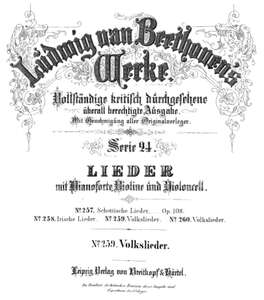 The tune's ascent through elite European musical culture continued in the following decade. Joseph Haydn also wrote a choral arrangement of the Latin hymn [6], and, separately, between roughly 1809 and 1816, Beethoven arranged "O Sanctissima (Sicilian)" as a trio, one of a set of folk-song settings he made for the Scottish publisher George Thomson [7]. As the Grove Dictionary entry on the collaboration notes, "Beethoven appears to have begun arranging folksongs for the Scottish publisher George Thomson in late 1809 or early 1810. He continued to do so at intervals until at least 1816. It was his own idea to extend the scope of the project to include songs not of British origin; most of these were never published by Thomson." [8] By the early nineteenth century, then, a devotional song attributed to Sicilian seamen had been absorbed into the drawing-room repertoire of Romantic Europe, arranged independently by two of its most celebrated composers, a full century and a half before it would become, in a wholly different register, a song of American Black protest.
The tune's German afterlife did not stop with Herder, either: around 1816, the same melody was fitted with new words by the writer Johann Daniel Falk, referring not to the Virgin but to the birth of Christ, and became "O du fröhliche" ("O, how joyfully") [9], still one of the best-known Christmas carols in the German-speaking world; by 1835 it had also been adapted, in English, for the recessional hymn "Lord, Dismiss Us With Thy Blessing." [10] Within little more than a generation, the same simple rising phrase had already crossed from a Sicilian devotional custom into a folk-song anthology, a German Christmas carol, and an English hymnal, evidence of exactly the kind of migratory life a genuinely haunting melody tends to lead. And that last adaptation matters for what follows: by 1901 the "Sicilian Mariners" tune, under that hymn pairing, was one of the most widely printed and sung melodies in American Protestant hymnody, carried through the nineteenth century in shape-note tunebooks and mainstream hymnals alike, common enough in American Methodist worship in particular that it would have been entirely familiar to any American congregation of the period.
Where the melody's second half comes from is much less clear. Some sources quote "I'll Be Like Him" by the gospel singer Roberta Martin, others instead reference a different nineteenth-century hymn, "I'll Be All Right" itself descended from the spiritual "No More Auction Block". Neither claim is verifiable against a primary recording.
The history of the lyrics
The words and the sentiment behind "We Shall Overcome" descend from an entirely separate lineage, one rooted not in European travel writing but in Black American gospel hymnody and Southern labour struggle.
The starting point is Reverend Charles Albert Tindley, generally regarded as one of the founding figures of African American gospel music. In 1901, Tindley and the Reverend A. R. Shockly published the hymnal New Songs of the Gospel [11], which included a song titled "I'll Overcome Some Day" on a melody quite distinct from the Sicilian hymn discussed above:
This world is one great battlefield With forces all arrayed, If in my heart I do not yield I'll overcome some day.
Tindley supplied the hope of eventual victory, the title, and the pronoun ("I'll overcome"), set to a tune of his own. The song's move from personal devotion towards collective, secular assertion first happened in 1908, when more than 10,000 Black and white members of District 20 of the United Mine Workers, in and around Birmingham, Alabama, struck for two months against a proposed wage cut.
Although the union was ultimately defeated, the strikers sustained themselves by singing "We Will Overcome Some Day". A letter printed on the front page of the February 1909 United Mine Workers Journal preserves a miner's own appeal: "Dear Brothers, let us not drop that old song, but still sing it. If we stick together we will overcome some day." [12] This is the first documented instance of the song being sung outside a religious setting, in a mixed-race labour context, and it already shows the pronoun shift from "I" to "We" that would later be attributed, more famously, to a different strike entirely. It seems reasonable to infer that this more militant, secular version, or at least the memory of it, persisted in the labour movement through the 1920s, its performance style drawing closer to another folk-based spiritual, "I'll Be All Right."
Two further composers reshaped the material in the following decades, and their contributions matter precisely because both would later be effectively written out of the song's official authorship. 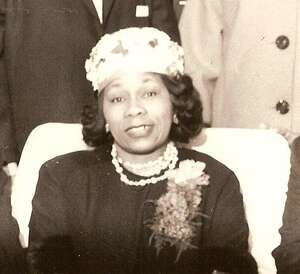 In 1930 Louise Shropshire, a Cincinnati choir director and music minister at Revelation Baptist Church, composed "If My Jesus Wills" [13]:
I'll Overcome, I'll Overcome, I'll Overcome Someday If My Jesus Wills, I Do Believe, I'll Overcome Someday
The word "I" here is not incidental. It reflects, as the Freedom Singers' Bernice Johnson Reagon would later explain, a real pattern in Black collective-expression songs: "In the Black community, if you want to express the group, you have to say I, because if you say we, I have no idea who's gonna be there... There are many Black traditional collective-expression songs where it's I, because in order for you to get a group, you have to have I's." [14]
The transformation that gave the song both its now-canonical pronoun and its lasting association with collective struggle took place, once again, on a picket line. In October 1945, some 1,100 Black and white employees of the American Tobacco Company cigar factory in Charleston, South Carolina, most of them African American women, struck for higher pay and better conditions. To sustain morale through the cold, wet winter of 1945–46, one of the strikers, Lucille Simmons, a labourer with what one contemporary account called a captivating alto voice, led a slow, "long meter style" rendition of the song each night, singing "I Will Overcome." [15] It was the tobacco workers themselves, in this telling, who changed the pronoun from "I" to "We" turning a hymn of individual perseverance into a statement of collective purpose, although this shift had at least one earlier precedent in the labour movement. As the Charleston strike wore on, the lyrics kept mutating to match the moment: "We will organize" "We will win our rights" "We will win this fight."
The strike ended in March 1946 with modest concessions. Not long after, a few of its participants, among them an African American striker named Anna Lee Bonneau, travelled to the Highlander Folk School in the hills of southeastern Tennessee and shared the song with the school's white music director, Zilphia Horton, carrying it out of the Black gospel-and-labour lineage traced in this section and into the very different institutional setting where it would finally be fixed together with its melody.
This second lineage sits within a larger and still under-examined history of alliance, and friction, between the American labour movement and the movement for Black civil rights.
When the melody and the lyrics come together
The earliest surviving printed version that presents words recognisably in the gospel-and-labour lineage together with a tune recognisably descended from the Sicilian hymn is Zilphia Horton's 1948 publication at Highlander.
Highlander Folk School was founded in 1932 on a farm in Monteagle, Tennessee, a coal-mining town near Chattanooga. One of the very few racially integrated institutions in the American South, Highlander had trained labour organisers since its founding, working with the Congress of Industrial Organizations and offering a scholarship in Eleanor Roosevelt's name while supporting farmers, textile workers, and coal miners across racial lines. Located in one of the poorest counties in the country, Highlander practised what its founder Myles Horton called a pedagogy of the oppressed avant la lettre: "We made it clear that we weren't bringing people together to tell them what to do. We had confidence in their ability to share their experiences and learn from each other and learn to trust their own judgment" an approach that, as the Los Angeles Times observed in Myles Horton's 1990 obituary, mixed classes on politics and economics with square dances and local lore. [16]
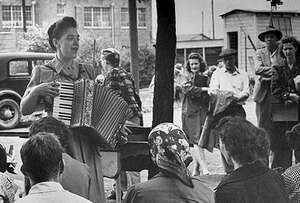
It was there that the song was refined by Zilphia Horton, the school's first music director, who credited the interracial CIO Food and Tobacco Workers' Union with teaching it to her when the song was printed, with her introduction, in People's Songs Bulletin No. 3, with the instruction that it be "sung very slow and freely." [17] This 1948 sheet music is, as far as the surviving documentation shows, the point at which the song's two long-separate histories finally appear together on paper. As Highlander's institutional mission shifted after 1945 from labour organising towards civil rights, music took on an even more central pedagogical role, dovetailing with the Southern Black tradition of song as a mode of communication and protest, and the school became a critical incubator for future civil rights leadership.
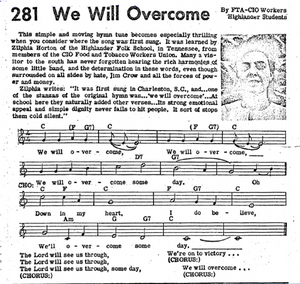
It was Horton who taught the song to the white folk singer and activist Pete Seeger, who changed "We Will Overcome" to "We Shall Overcome" and added the verse "We'll walk hand in hand, the whole wide world around."
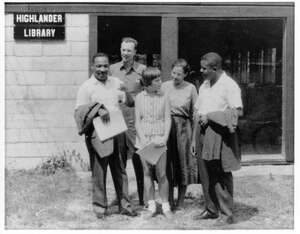
Seeger performed the song, on banjo, at Highlander's twenty-fifth anniversary celebration on 2 September 1957, where Martin Luther King Jr. delivered the keynote address; King is remembered as telling the others in the car on the drive back to Louisville that night, "There's something about that song that haunts you". The song passed through at least two further hands before reaching the movement at large: the folk singer Frank Hamilton picked up Seeger's version, and the young Guy Carawan, a South Carolina-born, Los Angeles-raised singer later described, not without a certain irony given the song's Black gospel roots, as "a white ... proto-hippie" learned it from Hamilton.
Many of the singers who carried "We Shall Overcome" into protests nationwide were, like these three, white, and the word at the centre of the song's title was not something every Black organiser simply accepted. Bernice Johnson Reagon, later a member of the Freedom Singers, recalled resisting the change from "I" to "we" when she first encountered it: "We'd been singing the song all our lives, and here's this guy who just learned the song and he's telling us how to sing it." Her eventual acceptance was not a simple concessionbut a deliberate reframing "What that statement ['We shall overcome'] does for me is document the presence of Black and white people in this country, fighting against injustice." [14]
In July 1959, a youth choir from a Montgomery church, invited to Highlander so that its members could, in Myles Horton's words, "know there were white people that they could deal with as equals" was watching a documentary film, Face of the South, in a darkened room when armed raiders, vigilantes and plainclothes police, burst in with flashlights, demanding the lights be turned on. No one at Highlander complied. As the raiders grew furious, the students began to sing "We Shall Overcome" and one of them, Mary Ethel Dozier, responded to the raiders by improvising a new verse on the spot: "We are not afraid, we are not afraid today." The line stayed in the song from that point on.
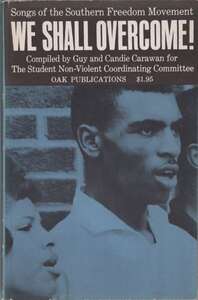
Guy Carawan stepped in as Highlander's song leader in 1959, by which point the school's focus had shifted decisively to nonviolent civil rights activism. According to one retrospective account, "'We Shall Overcome' would not become the Civil Rights anthem, however, until it was sung by a white, South Carolina-born proto-hippie from Los Angeles, who learned the tune from Seeger via fellow Californian folkie Frank Hamilton and others." When Carawan performed the song at the founding meeting of the Student Nonviolent Coordinating Committee in Raleigh, North Carolina, in 1960, it was formally adopted as an official movement song. Black youth activists then remade it again, speeding the tempo back up and shifting it, notably, into 12/8 time, a metre closely associated with gospel and blues phrasing. "The song was different than in union days" one SNCC organiser recalled. "We put more soul in, a sort of rocking quality, to stir one's inner feeling. When you got through singing it, you could walk over a bed of hot coals, and you wouldn't notice."
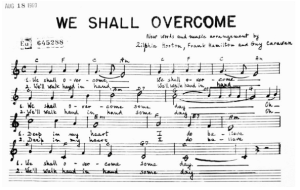
On 27 October 1960 the song received its first formal publication, issued by Ludlow Music and copyrighted in the names of Zilphia Horton, Frank Hamilton, and Guy Carawan. [18] It was registered as a derivative work; tellingly, no original source was listed, a detail that would matter a great deal five decades later, when the question of who actually owned "We Shall Overcome" was finally tested in court. This is the first document that fixes, together, most of the words and music people would recognise today. The published lyrics ran:
We shall overcome, we shall overcome, we shall overcome someday Oh, deep in my heart I do believe we shall overcome someday
We'll walk hand in hand. We shall all be free. We shall live in peace. The Lord will see us through
The song underwent one further, and arguably decisive, transformation during the civil rights campaign waged in Albany, Georgia in 1961 and 1962. Until that point, despite the palpable Black musical influences already folded into it, "We Shall Overcome" was still generally performed in a manner closer to the Southern white folk and hymnody tradition in which Seeger, Hamilton, and Carawan had transmitted it. In Albany, young Black activists led by Bernice Johnson Reagon and associated with SNCC took the song's basic structure and reworked it fundamentally: they syncopated the rhythm, slowed the tempo, and opened the performance to spontaneous vocal punctuation from the assembled singer-protestors at mass meetings and demonstrations, redefining the song with the call-and-response patterns and improvisational textures of the Black gospel tradition. It is this Albany version, continually refined to meet the demands of particular occasions and particular places, that most vividly evokes the movement's early Southern campaigns, and that arguably completed the song's passage from a white-mediated folk-revival artifact back into an idiom fully continuous with the Black church music from which its melodic and rhythmic materials had originally been drawn.
What this trajectory illustrates, about the movement as much as about the song, is a shared disposition towards hybridity. The civil rights movement, for all its moral seriousness, its constitutional argumentation, and its efforts at coherent strategic planning, was prepared to use whatever served the practical work of dismantling segregation and disenfranchisement. Black American music displayed the same disposition. It has certainly favoured particular techniques (syncopated, danceable rhythms among them), but its most influential and popular practitioners have rarely let notions of authenticity stand in the way of a good tune, an effective arrangement, or a telling lyric, regardless of that material's provenance. "We Shall Overcome" is close to a limit case of this cultural hybridism: a Catholic Sicilian hymn, filtered through German Romantic folklore and Beethoven's arranging pen, recombined with an African American gospel hymn, claimed and altered by striking tobacco workers, refined at a biracial labour school, carried into wider circulation by white folk revivalists, and finally reclaimed and remade by Black student organisers into the song the movement actually needed.
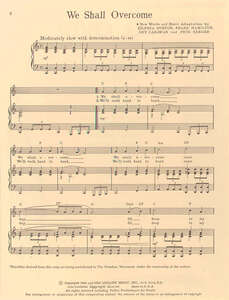
A second Ludlow Music publication followed on 7 October 1963, adding Pete Seeger to the copyright alongside Horton, Hamilton, and Carawan, described as "New Matter: arr. for voice & piano with guitar chords & some new words" and carrying the note that "royalties derived from this song are being contributed to The Freedom Movement under the trusteeship of the writers." [19] The expanded lyrics now included "The truth will make us free" "We are not afraid" and "The whole wide world around" completing the verse set as it is commonly sung today.
The March on Washington, 28 August 1963
Joan Baez had been a fixture of the American folk revival since her debut at the Newport Folk Festival in 1959, at eighteen, and had grown up in a Quaker household with an early, personal commitment to pacifism and nonviolent activism that predated her singing career. Earlier that same year, in May 1963, at the height of the Birmingham campaign, she performed and recorded "We Shall Overcome" live at Miles College, a historically Black college in Birmingham, on the very day the city saw a mass arrest of civil-rights demonstrators. [20] A month before the March on Washington, in July 1963, she sang it again at the Newport Folk Festival, in a much-photographed closing performance in which she, Bob Dylan, Pete Seeger, Theodore Bikel, Peter, Paul and Mary, and the Albany, Georgia-based vocal quartet the Freedom Singers stood on stage together, hands joined, and sang the song as one voice. [21]
The March on Washington for Jobs and Freedom was the culmination of months of planning by the labour and civil rights strategist Bayard Rustin and the veteran labour leader A. Philip Randolph, who had first proposed a march on the capital for Black employment rights back in the early 1940s and revived the idea, together with King, James Farmer, and John Lewis, in the spring of 1963, at the height of the Birmingham campaign. Its full title signalled its dual character, a labour demonstration for jobs and economic justice as much as a civil rights demonstration for legal equality, and it drew support from a coalition of civil rights organisations, major labour unions including the United Auto Workers, and religious groups across denominations. An estimated 250,000 people gathered on the National Mall between the Washington Monument and the Lincoln Memorial, making it, at the time, the largest demonstration ever held in the American capital and one of the first to receive extensive live television coverage, which did much to carry both the day's imagery and its music to a national audience that had never witnessed anything like it. [22]
It was in this setting that Joan Baez led the crowd in "We Shall Overcome".
Later that same afternoon, from the same platform, Martin Luther King Jr. delivered "I Have a Dream" now remembered as the day's defining moment.
The song in the movement, 1963–1968
"We Shall Overcome" was inseparable from the movement's public identity, but its most significant work continued to happen away from any stage. Mourners sang it after the bodies of four young girls were recovered from the Sixteenth Street Baptist Church in Birmingham, bombed in September 1963. The civil rights worker Viola Liuzzo reportedly sang it as she lay dying of gunshot wounds after being murdered in Alabama in March 1965. John Lewis, his skull fractured by state troopers on the Edmund Pettus Bridge on Bloody Sunday, 7 March 1965, later said the song "gave you a sense of faith, a sense of strength".
The song's formal political legitimation arrived on 15 March 1965, when President Lyndon Johnson, himself a Southerner who had supported segregationist policies earlier in his career, addressed a joint session of Congress in the wake of Bloody Sunday. Some seventy million Americans watched as Johnson framed racial discrimination not as a "Negro problem" but as "an American problem" and closed his call for a new voting rights law with the words "And we shall overcome". As King watched the broadcast from a living room in Selma, a tear ran down his cheek. Three years later, in his final sermon, delivered in Memphis on 31 March 1968, days before his assassination, King recited the words of "We Shall Overcome" once more.
A global afterlife
The song's American history is only part of its story. It was reportedly sung on the gallows of Pretoria Central Prison by the South African anti-apartheid militant John Harris before his execution; it was carried, in Spanish, among United States farm workers during the strikes and grape boycotts of the late 1960s; and it travelled far beyond the borders of any single national struggle, taken up by students and workers at Tiananmen Square in 1989, in Northern Ireland, in South Korea, in Lebanon, in India, and across the collapsing state-socialist regimes of Eastern Europe, including at the fall of the Berlin Wall.
Credit, erasure, and the courts
Set the credited authorship of "We Shall Overcome" against the credited authorship of its component parts, and a stark asymmetry appears. The 1960 and 1963 Ludlow Music registrations name exactly four people: Zilphia Horton, Frank Hamilton, Guy Carawan, and Pete Seeger. Three were white men and one was a white woman. Almost everyone else whose singing or composing this article has traced as material to the song's development was Black, and several were Black women whose names appear nowhere on the copyright: Louise Shropshire, Lucille Simmons, Anna Lee Bonneau, Mary Ethel Dozier, and the unnamed collective of Black tobacco-union members from whom Zilphia Horton herself said she had learned the song. Even Charles Albert Tindley, whose 1901 hymn supplied the title and the underlying sentiment, went unmentioned in either registration.
According to the Smithsonian Folkways collection notes, Horton, Hamilton, Carawan, and Seeger "copyrighted the song and listed themselves as composers, out of concern that others would exploit the song commercially" and routed all resulting royalties to a nonprofit, the We Shall Overcome Fund, rather than keeping them personally. This was presented as a defensive registration, meant to keep the song out of purely commercial hands rather than to enrich its named authors, and Seeger had good reason, by 1960, to take that risk seriously. In 1951–52, Seeger's own group, the Weavers, had recorded "Wimoweh" an adaptation of "Mbube" a song written and recorded in 1939 by the South African migrant worker Solomon Linda, who had assigned his worldwide rights to a record company for the equivalent of about ten shillings. The Weavers' recording credited the song not to Linda but to "Paul Campbell" a pseudonym their publisher routinely attached to songs of folk or uncertain origin. Seeger later expressed regret about the arrangement and privately sent Linda money once he understood how little the composer had received. Later, in 1961, the melody was reworked by another band (the Tokens) in what became "The Lion Sleeps Tonight", which topped the charts and ultimately became the main track of Disney's film "The Lion King".
Despite the sincerity of that defensive intention, the 1960 registration's own language ("registered as a derivative work, but no original source is listed") left the question of underlying ownership formally unresolved, and it was eventually tested in a United States federal court. In 2016, the production company behind the documentary We Shall Overcome and the nonprofit We Shall Overcome Foundation sued Ludlow Music and its parent, The Richmond Organization, after being asked to pay a reported $100,000 licence fee to use the song. The plaintiffs argued that the melody and lyrics registered in 1960 and 1963 were not sufficiently original, relative to the 1948 People's Songs sheet music already in the public domain, to sustain an independent copyright. In September 2017, Judge Denise Cote of the Southern District of New York agreed, ruling that the song's first verse, musically and lyrically almost identical to the 1948 version, lacked the originality required of a copyrightable derivative work. In January 2018 the parties settled: Ludlow agreed it would no longer claim copyright in the melody or lyrics of any verse of "We Shall Overcome" placing the entire song in the public domain. [23]
That outcome carried a real cost as well as a benefit. Royalties had, since the 1960s, been donated to the Highlander Research and Education Center, which distributed them as grants and scholarships within African American communities, predominantly in the South, through its We Shall Overcome Fund; Ludlow's public statement at the time of the settlement warned that losing copyright protection would curtail that funding and open the song to "inaccurate historical uses, commercials, parodies, spoofs and jokes." Both things can be true at once: the copyright had, for decades, functioned less as private extraction than as an unusual funding mechanism for Black Southern grassroots organisations, and it had also, from its origin, rested on four white names while erasing the Black women whose labour the song was substantially built from. The litigation did not resolve that second problem so much as make it newly visible. Renewed attention, specifically prompted by the case, fell on Louise Shropshire, whose family and advocates, most prominently Isaias Gamboa, had long argued that her authorship of the song's lyrical and structural core, though not its final melody, had never been properly credited or compensated; Pete Seeger himself told a researcher in 2006 that "nobody knows exactly who wrote the original." Shropshire, who died in 1993, was posthumously inducted into the Ohio Civil Rights Hall of Fame in the wake of the 2018 ruling, a small, late, and non-monetary correction, arrived at only because a documentary filmmaker's commercial dispute forced the question of authorship back open.
Read across the song's full two-hundred-year documented history, this pattern is not an isolated legal footnote but a structural constant, and one this article has traced from its very first page. Burney and Herder collected the Sicilian hymn within an Enlightenment apparatus of classification that named its own collectors and left the Sicilian singers themselves anonymous. Tindley's 1901 hymnal at least bears his name, but the labour of the Charleston tobacco strikers, the informal teaching that carried the song into Highlander, and the compositional debt owed to Louise Shropshire went formally unrecorded for decades. The people credited by name at every stage where a name was fixed to paper (Burney, Herder, Beethoven, and later Horton, Hamilton, Carawan, Seeger) were, without exception, white, and mostly male; the people who actually sang, adapted, and recomposed the material into something worth naming were disproportionately Black, and disproportionately, at the song's most decisive turning points, women. "We Shall Overcome" is, in that sense, a case study in how a work becomes collectively authored in practice while remaining singly owned on paper.
But the copyright dispute, resolved only in 2017 and 2018, is the last and least interesting thing this song's history has to teach. What actually carried "We Shall Overcome" across two and a half centuries, four continents, and at least five distinct musical idioms was neither its legal owners nor its eventual court case, but two much older facts about how songs like this one actually live. The first is that a protest song is never finished: it is rewritten, verse by verse, by whoever needs it in the moment they need it, an "I" becomes a "we" on a picket line, more than once, independently; a raided, frightened room of teenagers turns "we're not afraid" into a sung fact rather than a hope; a slow labour hymn speeds up and drops into 12/8 time the moment Black student organisers need it to carry a march rather than console a mourner. Each of those changes is a small act of testimony, a real experience pressed directly into the song's own structure, which is why the song could serve a mining strike, a tobacco strike, a police raid, a funeral, and a president's address to Congress without ever sounding borrowed in any of those settings. The second fact is simpler and harder to explain: the melodic phrase itself, that rising opening gesture first fixed in print in 1792, has an almost inexplicable power to lodge itself in the mind. It moved Beethoven and Haydn, independently of each other, to arrange it. It made Martin Luther King Jr. hum it, unprompted, in the back of a car, before he could even remember its name. "There's something about that song that haunts you" he said, and whatever it is, it was already at work on an anonymous Sicilian congregation in the eighteenth century, and it is still at work today.
Sources
This essay was originally written in 2013 and it has been reworked in 2026. Some key sources that provide a detailed history of the song are:
- Wikipedia, "We Shall Overcome"
- Encyclopaedia Britannica, "We Shall Overcome"
- Documentary: "The Inspiring Force Of 'We Shall Overcome'" (2013)
- Ethan J. Kytle and Blain Roberts, "Birth of a Freedom Anthem", The New York Times, 14 March 2015
- Victor V. Bobetsky (ed.), We Shall Overcome: Essays on a Great American Song (Rowman & Littlefield, 2015)
References in the text:
- "The Sicilian Mariner's Hymn to the Virgin", European Magazine and London Review, vol. 22 (November 1792), pp. 385–386: Isaac Reed (ed.)
- obituary of "William Seward, Esq.", European Magazine and London Review, vol. 36 (October 1799), pp. 219–220
- Johann Gottfried Herder, "An die Jungfrau Maria: Ein sizilianisches Schifferlied", Stimmen der Völker in Liedern (Tübingen: Johann Müller, 1807 posthumous edition), pp. 175–176
- Vanessa Agnew, Enlightenment Orpheus: The Power of Music in Other Worlds (Oxford University Press, 2008)
- Philip V. Bohlman (ed. and trans.), Song Loves the Masses: Herder on Music and Nationalism (University of California Press, 2017, and Philip V. Bohlman, Translating Herder Translating: Cultural Translation and the Making of Modernity
- Haydn's choral arrangement, Hoboken XXIIIc:F2
- George Thomson (ed.), Twelve Songs of Various Nationality, WoO 157, trio (London/Edinburgh, 1816)
- Grove Dictionary of Music
- Ulrich Parent and Martin Rössler, "O du fröhliche", in Liederkunde zum Evangelischen Gesangbuch, vol. 4 (2002)
- Lowell Mason and Timothy B. Mason (eds.), The Sacred Harp or Eclectic Harmony (1835), "Lord, Dismiss Us With Thy Blessing"
- Charles Albert Tindley and A. R. Shockly, New Songs of the Gospel (1901)
- United Mine Workers Journal, front page, February 1909
- Louise Shropshire, "If My Jesus Wills" (composed 1930, published 1942, copyrighted 1954)
- Bernice Johnson Reagon, interview with Noah Adams, NPR (1999)
- North Carolina Department of Cultural Resources, on the 1945–46 Charleston Food and Tobacco Workers Union strike and the Winston-Salem Local 22 historical marker
- Kristina Lindgren, "Myles Horton, 84, Founder of Early Civil Rights Center", Los Angeles Times, 21 January 1990
- People's Songs, Bulletin No. 3 (8 September 1948)
- Ludlow Music, first publication of "We Shall Overcome" (27 October 1960)
- Ludlow Music, second publication with new words (7 October 1963)
- Joan Baez in Concert, Part 2 (Vanguard, 1963), recorded live at Miles College, Birmingham, May 1963
- Newport Historical Society, "The Newport Folk Festival as a Reflection of the American Sixties"
- Martin Luther King Jr. Research and Education Institute, Stanford University, "March on Washington for Jobs and Freedom" and "'Freedom!': Black Women Speak at the March on Washington"; National Museum of African American History and Culture, "Notes on the March on Washington"; National Museum of American History, program of the March on Washington for Jobs and Freedom; NAACP Legal Defense Fund, "The 1963 March on Washington for Jobs and Freedom"
- On the 2017–2018 litigation and settlement: Judge Denise Cote, S.D.N.Y., summary judgment opinion (September 2017); NPR, "Federal Judge Rules First Verse Of 'We Shall Overcome' Public Domain" (2017); The Hollywood Reporter and Billboard, "Ludlow Music Agrees 'We Shall Overcome' Is in Public Domain in Legal Settlement" (January 2018); KQED Arts, "Civil Rights Song 'We Shall Overcome' Part of Public Domain"; Herrick, Feinstein LLP and the Dramatists Guild, legal analyses of the ruling; TheGrio, Essence, and Blavity, on Louise Shropshire's posthumous recognition and induction into the Ohio Civil Rights Hall of Fame; Smithsonian Folkways Recordings